

Recently my feed blew up with notes about prom and there was a firestorm when I presented my flaming hot take.
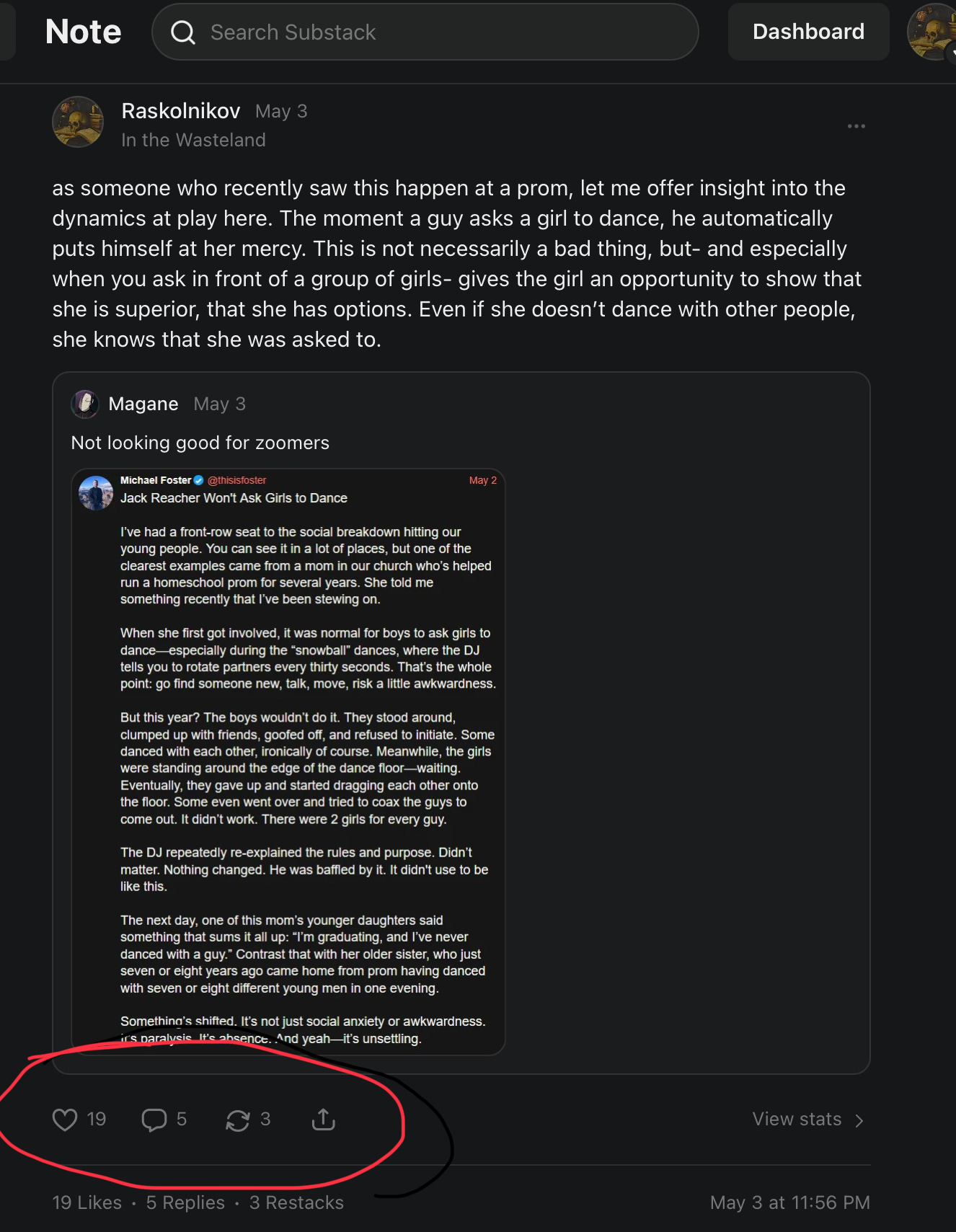
(I don’t get much engagement) Most people seemed to agree with me and to be fair, my note was pretty in line with the prevailing sentiment among men, especially those on the right, namely that the Zoomers are cooked. The girls have such high expectations and unrealistic ideas of romance all while imprisoning men in the longhouse that men have little choice but to preclude themselves from the romantic ideal. Only a fool would bet when the house is so stacked against him. What is more, these men are all watching porn and vaping the day away, getting their dopamine from the simulation of that which they are too afraid to actively seek. As with any dichotomy, there are layers to this and I would like to explore some of the patterns I have seen as a– I figure I'll say it since I won’t be for much longer– high school senior on the front lines of the romance wars.
First and foremost, I must address the elephant in the room: social media. The effect that social media has had on gender relations can not be understated as in many ways it colors the lens through which young people see the world today. Among the most radical changes brought about by social media is the commodification and quantification of interaction. By introducing a quantifiable measure of popularity to the commoner, social interactions now become transactional and necessarily artificial. Business is business, and when you are in the business of getting popular or obtaining validation, you need to keep your eyes open always. The nature of social media allows anything, however trivial, to serve as a source of engagement or connection. However, to make the most of these opportunities, you need to be always aware of what you're looking for. Regardless of how enthralling the moment is, you need to remember to post a picture so that everyone else knows what you did or how you looked doing it. Thus, every aspect of life suddenly loses value for its own sake and merely becomes a conduit to popularity. This applies to relationships, or their absence, as well. Thirst trapping and the resulting likes are a smart investment from a mercenary perspective. Even if any relationships or interactions are superficial, they go as deep as they need to to provide the dopamine that young people have come to crave.
Much like the American dollar, likes only have value if people trust the platform to assure them of that value. Yet, unlike the Fed ( or like the Fed if that is your inclination), Instagram ( I refer mostly to Instagram in this piece simply because it is the primary SM used by my peers) does not assign a definite value to their denominations of currency. Yet, rather than rendering them worthless, in many cases, this abstract value allows people to assign as much weight as they want. This is one way in which SM affects intersex interactions. Why did that cute girl like my story? Does he like me? If a person wants to know, they can talk to the person in question and see for themselves. But that ruins the magic of imagining. Anything can happen in theory. This Schroedinger’s romance can be anything you want provided you do not pursue it. In fact, if you like, you can imagine that each person of the opposite sex who liked that story is infatuated with you. If you wanted, you could have any of them. Not that you will initiate anything, of course, that would give the game away. The psychological pleasure of this paradigm certainly does get the blood flowing. You are wanted. People see you and think you are attractive or interesting. You are desired.
Not everyone on social media has this experience, however, and few have it continuously. Typically, only the most attractive or popular people can pull off the branding needed to maintain a constant flow of affirmation. The plebs either content themselves with the fleeting pleasures of a few likes or, more commonly, take the imaginary to the next level. Whereas a person might assign more thought and affection to a like than it is worth in reality, the detached nature of the internet makes more extreme fantasy even easier. That beautiful girl who you have never talked to? You can access her life with a few swipes. She might not follow you back and you may never interact with her, but you will know the events of her life as though you were a close friend. Just by searching up her name, you gain access to her life without ever having to go through the trouble of working up the courage to talk to her. This is the more innocent, though already lustful, iteration of such fantasies. The darker version involves pornography and the like. Both allow a momentarily satisfying simulacrum of intimacy that can soothe the tired soul for a spell before the hunger or real love returns.
The problem, however, is that as likes, comments, and the like are a currency, there must be a product; in social media, the user is the product. As in any market, the demand determines value. If you wish to stay valuable, you need to invest in your product. You need to ensure that there is demand for you and this in turn requires finding ways to pique others’ interest. Enter immodest posts, excessive posting, and unbalanced follower-to-following ratios. All these help boost both actual demand and the illusion of it. However, keeping up this image requires that people maintain a certain degree of detachment from real life. Hence the rise in depression and anxiety among young people particularly women. When your product relies on the illusion of perfection, you can not show any cracks in your armor. An arrow from Cupid, however, likewise represents a weakness. Lowering yourself to the pedestrian level of some guy or girl automatically names your price. Oh, you’re dating him? Huh, I thought you could do better. Suddenly, your value on the dating market has been determined and any illusion of getting with someone “better” is gone. Besides, why settle for some random person when you can pleasure yourself in the publicly available profiles of the highest echelons?
Finally, and perhaps most damning, is the nature of social media algorithms. I am not a computer scientist, so from a technical perspective I am completely inexperienced, but I have seen firsthand how comforting reels can be to the lonely man. Picture this, you are a single man, and your day may or may not have been good, but now you return home and are suddenly hit with an overwhelming sense of loneliness. You yearn to love, to show affection, to have intimacy, and to be known. Those desires might be obscured by more carnal urges, but at the end of the day, the soul wants love. You scroll through the following list or recommended follows and wish that maybe something might work out with one of those lasses. Finally, tired of seeing all the choices you fail to capitalize on (remember the commodification of relationships), you turn to reels. There the insecurities and fears of rejection seem to be communicated and assuaged by the luring sirens song of comfortable victimhood. “Women these days” “They just want a 6’ 6” guy” “Romanticism is dead” Seeing voluptuous strumpets thoughtlessly throwing about massively inflated expectations allows you to focus on the ‘real’ problems. Everything can be externalized and assigned to the forces that have destroyed modern society.
From the little I have seen of it, this is the appeal of the manosphere. There, the victimization of men is discussed, and the oppression they face daily gives a voice to the frustrations of a generation of men who have found themselves increasingly neutered in an effeminate society. For a moment, they can relish the experience of finding an object of their frustration: feminism, women in general, etc. In the thrill of finding a target, however, it is easy to turn frustration into resentment. This is another facet of the manosphere that often seeps into male discourse. The pain men feel either at their inability to approach women or the rejection and betrayal they have experienced at their hands begins to cloud them to the reality of the situation. They begin to see women as mindless opponents to dominate and exploit when possible, blind to the fact that the same thing is happening on their end. The result is an arms race where both sexes are convinced of the malice of the others and have a distrust that ultimately becomes a self-fulfilling prophecy. When they turn to their friends or social media, they simply reaffirm them: the problem isn’t you. I have seen this and regretfully, have participated in it. With both my female and male friends, no one ever wants to be the bad guy. Even if you were the one who already had three other girls you were thinking about, if your crush talks to multiple guys, they cross a line, etc. This results in a lack of accountability and double standards that make the other sex seem like a plotting band of cruel pigs because they do not live up to expectations that the other party does not adhere to either. Everyone claims to want a religious, respectful, romantic partner who will appreciate them for who they are. Yet they pursue worldly people and then are surprised when those people are prone to falling into worldly vice.
The upshot of this is that as Magane so aptly noted, things are not looking good for Zoomers. We are cooked, and until we learn to move past our vice and see each other as humans we will remain in the pathetic state that we are in now. In other news, water is wet. The only difference now is that we have technology aggravating the problem. That's all folks, I'll probably write more about this later because it's a topic near and dear to my heart as a single zoomer.
This is an amazing article that treats the issue with a truth and clarity which most are fearful to utilize. I will make one criticism though, you should remove "cooked" from your vocabulary and all other zoomerisms. We have to be role models and men after all. The few of us who can see these things.